
For homemade toy airplanes, RC aircraft, and free-flight models, the “best” airfoil depends much more on flight speed, Reynolds number, stability requirements, and construction method than it does on full-scale aircraft practice. An airfoil that performs wonderfully on a Boeing 787 may perform poorly on a small 12-inch wingspan rubber-powered model because model aircraft fly at much lower Reynolds numbers.
Below are the major airfoil categories and where they work best.
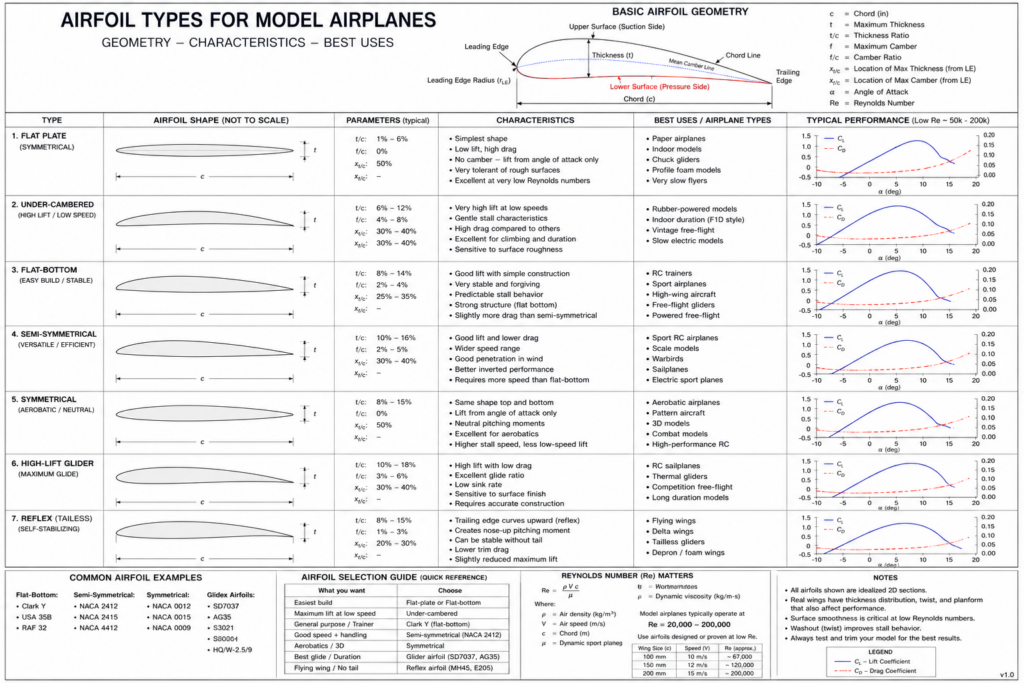
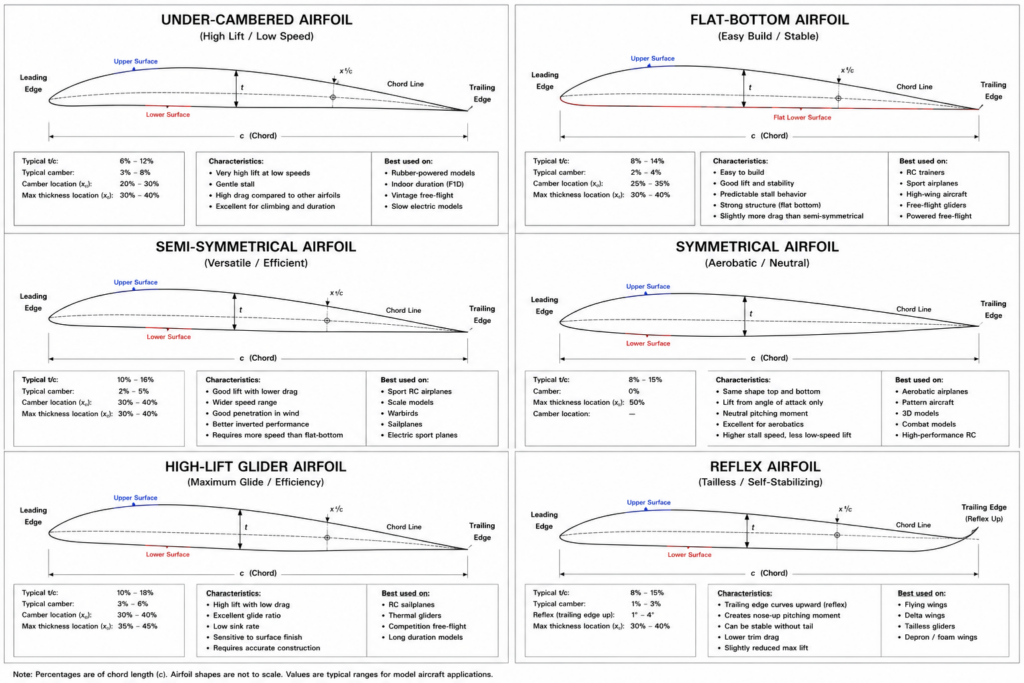
1. Flat Plate Airfoil
A flat plate is simply a sheet of balsa, foam, or Depron.
Advantages
- Extremely easy to build
- Very lightweight
- Low cost
- Surprisingly good at very low Reynolds numbers
- Very forgiving
Disadvantages
- High drag
- Poor glide ratio
- Lower lift than properly cambered airfoils
- Not efficient at higher speeds
Best Uses
- Indoor free-flight
- Chuck gliders
- Profile foam RC airplanes
- Slow flyers
- Trainers
Typical thickness:
- 1–6 mm
Construction:
- Foam
- Balsa sheet
- Coroplast
2. Under-Cambered Airfoil
The lower surface curves upward instead of remaining flat.
This produces excellent lift at low speed.
Advantages
- Highest lift at slow speed
- Excellent glide
- Gentle stall
- Great for climbing on low power
Disadvantages
- More drag
- Poor high-speed performance
- Difficult to build
Best Uses
- Rubber-powered models
- Indoor duration aircraft
- Small electric RC
- Vintage free-flight
Examples
- Clark YH undercambered versions
- Old Wakefield designs
- Indoor F1D-style models
3. Flat-Bottom Airfoil
Probably the most common airfoil for RC airplanes.
The bottom is mostly flat while the top is curved.
Advantages
- Easy to build
- Good lift
- Predictable handling
- Stable
- Strong wing structure
Disadvantages
- Not ideal for aerobatics
- Slightly more drag than symmetrical airfoils
Best Uses
- RC trainers
- Sport airplanes
- High-wing aircraft
- Free-flight gliders
- Powered free-flight
Popular examples
- Clark Y
- USA 35B
- RAF 32
4. Semi-Symmetrical Airfoil
The top is more curved than the bottom but neither surface is flat.
Advantages
- Good lift
- Lower drag
- Better inverted flight
- Good penetration into wind
- Wide speed range
Disadvantages
- Slightly harder to trim
- Requires more flying speed
Best Uses
- Sport RC airplanes
- Scale aircraft
- Warbirds
- Sailplanes
- Electric sport planes
Popular examples
- NACA 2412
- NACA 2415
- NACA 4412
5. Symmetrical Airfoil
Top and bottom are identical.
Lift is produced only by angle of attack.
Advantages
- Excellent aerobatics
- Same performance upright and inverted
- Neutral pitching behavior
- Precise control
Disadvantages
- Less lift at low speed
- Higher stall speed
- Poor choice for beginners
Best Uses
- Pattern aircraft
- 3D airplanes
- Aerobatics
- Combat models
Examples
- NACA 0012
- NACA 0015
6. High-Lift Glider Airfoils
Designed specifically for low drag and excellent lift over long periods.
Advantages
- Excellent glide ratio
- Efficient thermalling
- Low sink rate
- Long duration
Disadvantages
- Difficult to build accurately
- Sensitive to surface finish
- More difficult to trim
Best Uses
- RC sailplanes
- Thermal gliders
- Competition free-flight
Examples
- SD7037
- AG35
- S3021
7. Reflex Airfoils
The trailing edge curves upward.
This creates a nose-up pitching moment that can eliminate the need for a horizontal tail.
Advantages
- Stable without a tail
- Lower trim drag
- Perfect for flying wings
Disadvantages
- Slightly lower maximum lift
- Not suitable for conventional airplanes
Best Uses
- Flying wings
- Delta wings
- Tailless gliders
Examples
- MH45
- E205
Which Airfoil Should You Choose?
| Aircraft Type | Best Airfoil | Reason |
|---|---|---|
| Paper airplane | Flat plate | Simplest and lightest |
| Chuck glider | Flat plate or under-cambered | Stable, slow flight |
| Rubber-powered duration | Under-cambered | Maximum lift and endurance |
| Balsa free-flight glider | Flat-bottom or light under-camber | Easy trimming and good glide |
| RC trainer | Clark Y or similar flat-bottom | Stable and forgiving |
| RC bush plane | Thick flat-bottom | High lift, slow landing |
| RC warbird | Semi-symmetrical | Good speed and maneuverability |
| RC aerobatic | Symmetrical | Neutral handling |
| RC sailplane | Dedicated glider airfoil | High glide efficiency |
| Flying wing | Reflex | Tail-less stability |
Reynolds Number: Why It Matters
A key difference between model aircraft and full-size airplanes is the Reynolds number, which depends on wing size, speed, and air properties. Small models often fly at Reynolds numbers between about 20,000 and 200,000, where airflow is much more sensitive to surface finish and airfoil shape. Thin, lightly cambered sections or airfoils specifically designed for low Reynolds numbers often outperform scaled-down full-size airfoils.
Recommendations by Skill Level
Beginner
- Flat plate
- Clark Y
- Thick flat-bottom
- Large wing area
- High-wing configuration
Intermediate
- NACA 2412
- NACA 4412
- Semi-symmetrical airfoils
Advanced
- SD7037
- AG35
- S3021
- MH45 (for flying wings)
For Homemade Free-Flight Models
If your goal is to build lightweight balsa or foam free-flight aircraft, a practical progression is:
- Flat plate for quick prototypes and chuck gliders.
- Flat-bottom (Clark Y–style) for reliable powered or gliding free-flight models.
- Under-cambered for maximum duration and very slow flight.
- Low-Reynolds-number glider airfoils (such as SD7037) once you can build wings accurately.
This progression balances ease of construction with aerodynamic performance and is commonly followed by experienced model airplane builders.