
In basic terms, airplanes fly because four main forces act on them:
- Lift pushes the airplane upward.
- Weight (gravity) pulls it downward.
- Thrust from the engines pushes it forward.
- Drag (air resistance) pushes backward.
For an airplane to fly steadily, lift balances weight, and thrust balances drag.
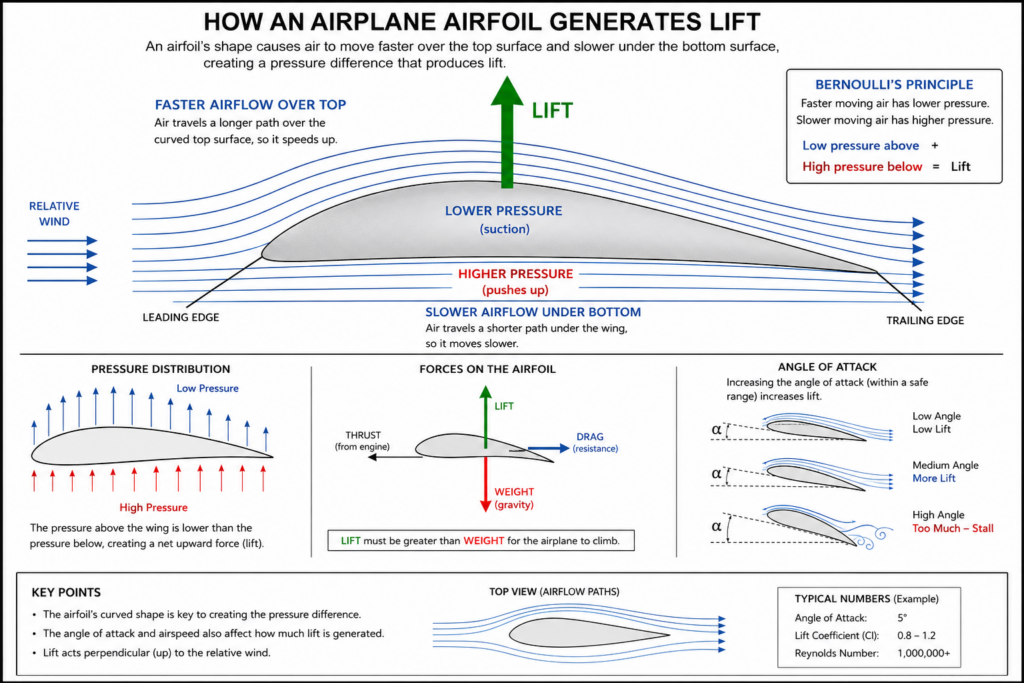
As the airplane moves forward, air flows over and under the wings. The wings are shaped to direct the airflow downward. According to Newton’s Third Law, if the wing pushes air downward, the air pushes the wing upward. At the same time, the wing’s shape and angle create differences in air pressure above and below the wing, which also contributes to lift. In reality, both the downward deflection of air and pressure differences are part of the same overall process that produces lift.
One interesting fact is that while engineers and scientists understand the principles of flight extremely well and can accurately design aircraft that fly safely, there is still no single, simple explanation that completely describes exactly how an airfoil (wing) generates lift in every situation. Early explanations—such as “the air on top must travel farther, so it must move faster”—are known to be incomplete or incorrect. Modern aerodynamics relies on complex fluid dynamics, combining pressure distributions, airflow, viscosity, circulation, and the wing’s interaction with the surrounding air. These theories predict lift very accurately, but there is no universally accepted “one-sentence” explanation that captures every aspect of how an airfoil works.
So, in short:
- Engines move the airplane forward.
- The wings redirect air downward and create pressure differences.
- Those effects generate lift, allowing the airplane to overcome gravity.
- Although the physics of flight is well understood and used successfully every day, the exact intuitive explanation of why an airfoil produces lift remains more complex than many textbook descriptions suggest.