
In free-flight gliders, fuselage length has a significant effect on stability, trim sensitivity, and turning behavior. The main reason is that changing the fuselage length changes the tail moment arm—the distance between the wing and the tail.
Here’s how a long fuselage compares to a short fuselage:
| Characteristic | Long Fuselage | Short Fuselage |
|---|---|---|
| Pitch stability | Higher | Lower |
| Yaw stability | Higher | Lower |
| Trim sensitivity | Less sensitive | More sensitive |
| Recovery from disturbances | More gradual and reliable | Quicker but less forgiving |
| Turning | Smoother, larger-radius turns | Tighter, more responsive turns |
| Tail effectiveness | Greater (for same tail size) | Less effective |
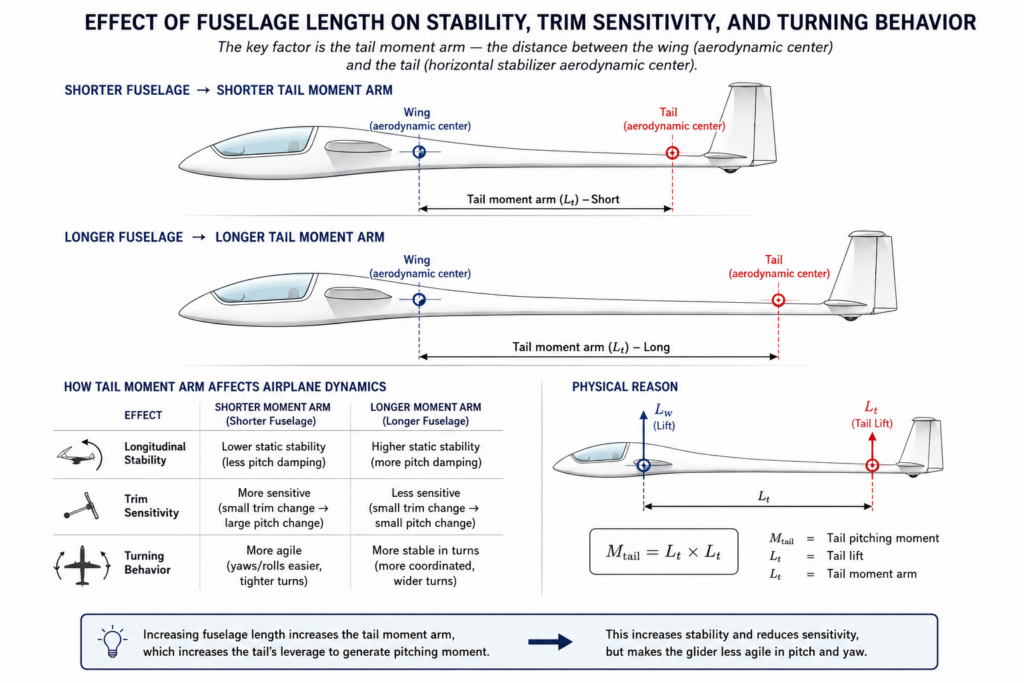
Long fuselage
A longer fuselage gives the tail more leverage over the airplane.
Advantages:
- More stable glide.
- Easier to trim because small changes have smaller effects.
- Better recovery after gusts or stalls.
- Smaller tail surfaces can often provide the same stability.
- Better directional stability during tow or launch.
Disadvantages:
- Responds more slowly to trim changes.
- Turns tend to be wider unless more rudder or wing adjustments are used.
- Slightly heavier due to the longer boom.
- More susceptible to structural flex if the boom isn’t stiff enough.
A long fuselage is often preferred for:
- Duration models.
- Calm-air thermal gliders.
- Beginner-friendly designs.
Short fuselage
A short fuselage reduces the tail’s leverage.
Advantages:
- More agile.
- Easier to produce tight circling turns, which can help center in small thermals.
- Lighter and more compact.
Disadvantages:
- More sensitive to tiny trim adjustments.
- Easier to over-trim.
- More affected by turbulence.
- Usually requires a larger tail to achieve comparable stability.
- Can be prone to oscillations (“porpoising”) if the center of gravity or incidence isn’t set carefully.
These models generally require more precise setup and trimming.
Effect on tail size
One useful relationship is the tail volume coefficient, which designers use to compare stability between different aircraft:
VH=SH×LHSW×cˉV_H = \frac{S_H \times L_H}{S_W \times \bar{c}}
where:
- SHS_H = horizontal tail area
- LHL_H = tail moment arm
- SWS_W = wing area
- cˉ\bar{c} = mean wing chord
If you shorten the fuselage, you typically need to increase the tail area to maintain the same tail volume and similar stability.
For example:
- Tail arm = 18 in, tail area = 20 sq in → tail volume = 360
- Tail arm = 12 in → you’d need about 30 sq in of tail area to achieve the same leverage.
Effects specific to free-flight
For free-flight gliders, designers usually favor a relatively long tail moment because it helps the model:
- Maintain a consistent glide.
- Transition smoothly from launch to glide.
- Circle steadily without hunting.
- Resist disturbances from changing air conditions.
Many successful duration gliders have tail moment arms around 2.5–3.5 times the wing chord, although the optimum depends on the wing planform, tail size, and intended flying style.
Rule of thumb
- Long fuselage: forgiving, stable, efficient, easier to trim.
- Short fuselage: agile, lighter, tighter turning, but requires more careful design and trimming.
For a free-flight duration glider, if weight can be kept low and the boom remains stiff, increasing the tail moment arm is often one of the most effective ways to improve consistent, hands-off flight.